 How to interpret a Performance Datasheet?
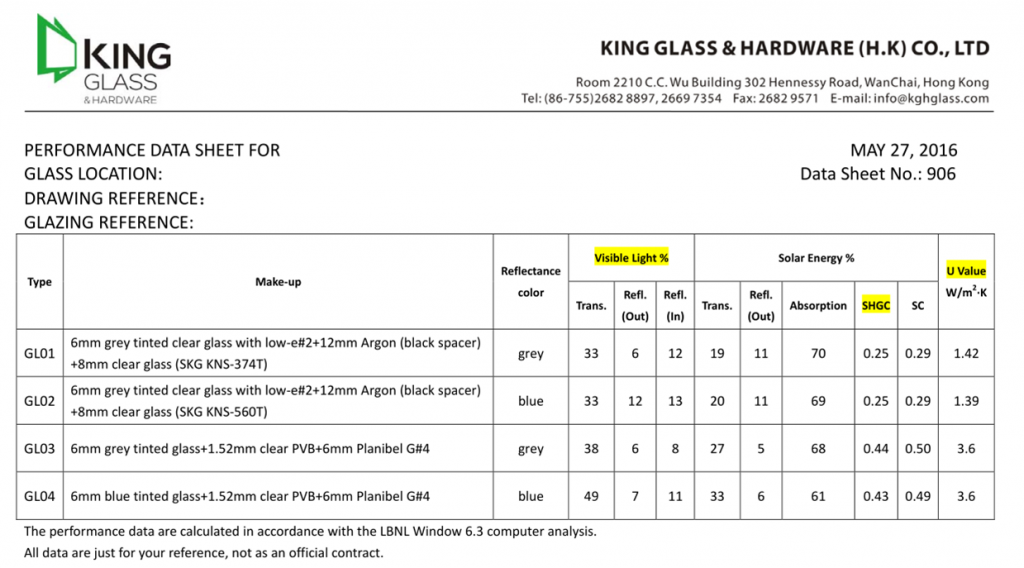
When an inquiry is received, King Glass will offer a combination of glass solution based on client’s glazing specification. There will normally be a performance datasheet provided based on the specifications. There are various parameters on the performance datasheet, among which Visible transmittance, SHGC(SC), and U-Value are considered key indicators of the performance of a specific glass product. 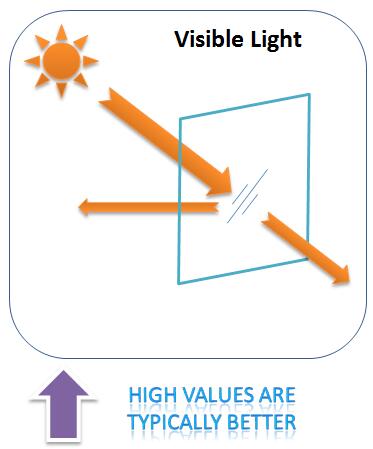
Visible Light
- Visible Light represents the portion of the sun’s spectrum that humans can see. In other words, Visible Light is Natural Daylight
- A Window that allows substantial visible light to pass through enables homes to have a naturally well lit atmosphere. This reduces the use of lights in your home, resulting in lower utility bills
- Worth noting, too much Visible Light can lead to unwanted glare and eye strain in rooms with televisions and computer monitors
- The best windows allow a substantial amount of Visible Light into the home while blocking other unwanted portions of the sun’s spectrum
SHGC
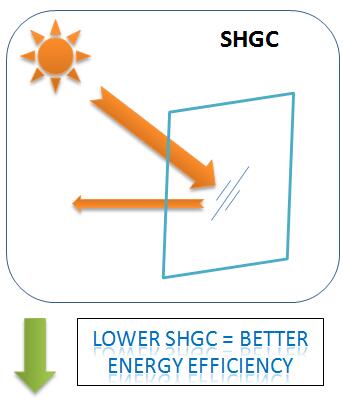
- SHGC (Solar Heat Gain Coefficient) represents the amount of heat from the sun allowed to pass through your window.
- The lower the SHGC value of glass, the less of the sun’s heat can pass through the window which represents savings on your energy bills.
- Winter – Low-E Glass helps stop furnace heat from escaping.
- Summer – Low-E glass helps stop the sun’s heat from warming your home.
- Infrared Energy is a portion of the sun’s energy that produces heat gain
- For optimal Benefits, you want your window to have the lowest SHGC value possible.
U-Value
Also known as the U-factor or coefficient of heat transmission, a measure of the rate of non-solar heat loss or gain through a material or assembly. U-values gauge how well a material allows heat to pass through. The lower the U-value, the greater a product’s resistance to heat flow and the better its insulating value. The inverse of (one divided by) the U-value is the R-value.
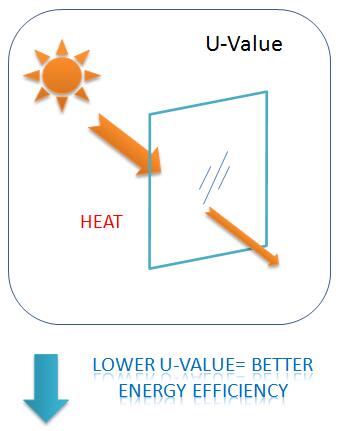
U-value is expressed in units of W/m2 °C or Btu/hr-sq ft °F. In the US, values are normally given for NFRC/ASHRAE winter conditions of 0°F (-18°C) outdoor temperature, 70°F (21°C) indoor temperature, 15 mph wind, and no solar load.
U-values are often quoted for windows and doors. In the case of a window, for example, the U-value may be expressed for the glass alone or the entire window, which includes the effect of the frame and the spacer materials.
To reduce U-factors, often a low-e coating is applied to glazing. Low-E coatings reduce heat loss, improving both heating and cooling performance. Windows can also be assembled to improve thermal performance. Some assembly strategies include using two or more layers of panes or films, low-conductance gas fills between the layers, and thermally improved edge spacers, which are placed between the panes.
]]>