Bathrooms Glass – shenzhen king glass & hardware co,.ltd https://arc.kghglass.com KING GLASS Fri, 10 Feb 2017 06:31:30 +0000 zh-Hans hourly 1 https://wordpress.org/?v=6.4.8 Curved tempered Glass https://arc.kghglass.com/product-details/curved-tempered-glass/ Tue, 21 Jun 2016 04:00:40 +0000 http://kghglass.com/?post_type=products&p=4134

Introduction

In another first we combines the strength of toughening with the latest in curved safety glass technology to offer architects, specifiers and interior designers a range of innovative and exciting design options.The continuous manufacturing process involves heating, then curving the glass to the required shape before finally toughening. By employing movable platens in the quenching process, the need for expensive press moulds has been eliminated. This technology allows each shape to be precisely moulded to customer specifications providing cost effective building solutions.

Terminology

To assist designers and clients when seeking quotations or placing orders the following terminology should be used:
Height: The straight edge length of the glass.
Depth: The distance between two parallel lines which enclose the curved glass.
Radius: The distance from the centre of the circle to the circumference of the circle
Degree: The angle of a segment in a circle expressed in degrees.
Tangent: A straight line extending from the arc of the curve.
Chord: The straight distance between the edges of the curve.
Girth: The distance around the surface of the curve.

Dimensional Specification

It should be noted that the maximum bending angle is 90˚, therefore a full circle (360˚) can only be achieved using four pieces of glass

Curved glass:

Thickness of glass: 3mm-25mm
Max size: 2800*6400                Min size: 50*50mm
Radius: 200mm-2800mm        Max Arch Height: 1200mm

Tempered curved glass:

(1). Curved Tempered Glass: 5-19mm (the first line) . Max Size: 2800*2650 Min Size: 600*200   Radius: 5-8mm R>=1300    10-12mm R>=1300  15-19mm R>=1300
(2). Curved Tempered Glass: 5-19mm (the second line)  Max Size: 2400*4000 Min Size: 600*400  Radius: 5-8mm R>=1100  10-12mm R>=1100  15-19mm R>=1300

Dimensional Specification 2

Curved toughened glass can only be curved in one plane (dimension).

Available Curves
It should be noted that the maximum bending angle is 90˚, therefore a full circle (360˚) can only be achieved using four pieces of glass.

Maximum Sizes
As height increases, the glass becomes more difficult to curve and therefore the minimum radius must be increased. Similarly as the glass weight and thickness increases, the maximum height must be decreased and the minimum radius increased

Measuring
Providing accurate dimensions for the purpose of manufacturing curved toughened is crucial to the whole process. In particular, the radius and girth dimension must be clearly stated as being measured from either:
a) the inside edge of the glass,
b) the centre of the glass。
c) the outside of the glass.

The preferred dimension is the radius from the inside edge of the glass, particularly for cylindrical shapes.
Where the chord and depth dimensions can be supplied, a computer program will be used to print out all necessary dimensions for clients checking and sign off.
Templates would be preferred for cylindrical shapes but are a must for cylindrical shapes with flats. All templates must be of a hard material such as plywood and remember the minimum possible radii as previously listed in Table。

521039Applications
we curved toughened safety glass has many and varied applications including:

Shopfronts and Internal Partitions
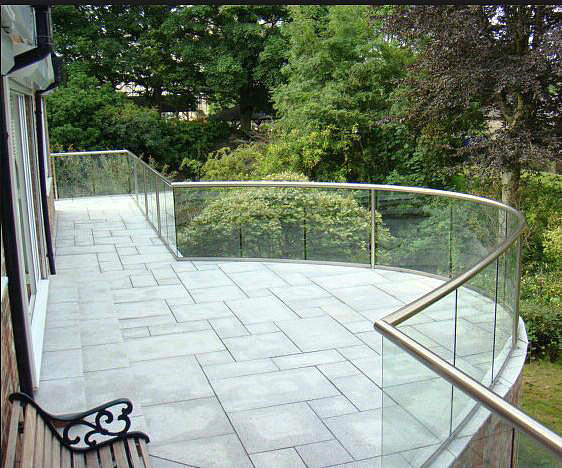
Balconies, Balustrades and Pool Fencing
Revolving Doors
Elevators and Lifts
Skylights and Covered Walkways
Bay Windows
Showerscreens
Display Cases, Deli bends and Food Cabinets
Glass Furniture
Windscreens

Maximum Sizes

It is also possible to incorporate Colourlite onto the surface of curved toughened glass panels.

Acceptance Criteria

Limitations
Curved toughened glass can only be curved in one plane (dimension).

The manufacturing limitations are as follows:

Maximum girth or curved dimension

2140mm (5mm-12mm)

Maximum height

3000mm (6mm/8mm)

3660mm (10mm/12mm)

For other thicknesses see Table

Minimum height 400mm

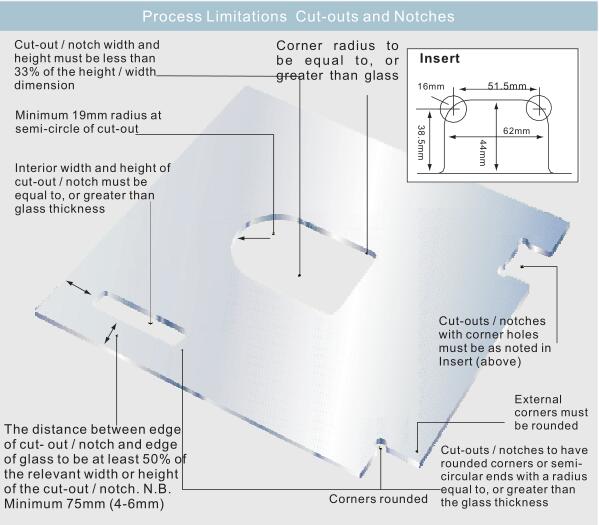
Edgework: As per flat toughened glass

Cut-outs: As per flat toughened glass

Holes / Spacings: As per flat toughened glass

Tolerances
Curve: To fit within ± 3mm of the specified shape or 6mm more than the glass thickness.
Local Warpage: At the curved edge: 1.5mm for glass up to 6mm thick and 3mm for glass over 6mm.

Standards
The appropriate standard for Architectural curved toughened glass covering the thickness range of 5mm – 12mm is AS/NZS 2208. For automotive glasses 5mm – 12mm thick, the appropriate standard is AS 2080.
As 3mm and 4mm are only available in heat strengthened and not fully toughened, such panels are not covered by the above standards as heat strengthened is not classified as a Grade A safety material.

]]>
Patten Glass https://arc.kghglass.com/product-details/patten-glass/ Wed, 01 Jun 2016 02:58:00 +0000 http://rttheme19.rtthemes.com/product-details/product-with-all-elements-2-2-2-2/

Patten glass used in architectural interior space, bathroom doors and Windows and needed to block the line of sight all sorts of occasions,ultra embossed glass has been widely used inphotovoltaic field.The installation can be pattern toward the interior, in order to enhance decorative sense; As a bathroom, shower toilet doors and Windows, glass doors and Windows, the room interval is used

Patterns: Aqualite, Bamboo, Beehive, Canelado, Chinchilla, Crystal,Diamond, Flora, Hishicross, Karatachi, Kasumi, Map, Masterlite, MayFlower, Millennium, Mistlite, Morgon II, Nashiji, Rain, Ripple, Silver Bead, Waterfall, Woven etc

SPECIFICATION:

Colors: Bronze, Grey, Blue, Green and Amber, etc.

Thickness: 3mm, 4mm, 5mm, 5.5mm, 6mm, 7.5mm and 8mm etc.

Artistic Decorative Glass
The artistic decorative glass is including great-engraved glass, erodent glass, inlayed glass and concave patterned glass.
Great-engraved Glass
Great engraved glass is multi-level carving and also displays the object shadow transition. It is elegant and not blundering,gorgeous and unconventional.
Erodent Glass
Lines are natural and facile, the grain is clear.
Concave Patterned Glass
Concave patterned glass is carving different patterns on good ordinary glass surface. The concave side is silvery white and shiny. Sand covered concave glass and Yaguang concave glass are best among the glass products.
Sand covered Concave Glass
Dim and strong hiding, crystal glistening, clearly demarcated and good three-dimensional effect.
Yaguang Concave Glass
Smooth surface, mark less, sleek and refreshing and clear texture.
Inlayed Glass
Inlayed glass is a kind of thee-stratum glass with artistic pattern and heated by tempered glass.
The appearance is beautiful and is heat insulation and burglarproof. It applies to home and hotel etc
]]>
Tempered Glass https://arc.kghglass.com/product-details/tempered-glass/ Thu, 23 Jun 2016 02:51:57 +0000 http://kghglass.com/?post_type=products&p=4154

The cut-to-size glass sheets are fed from the loading conveyer into the furnace where it oscillates back and forth on ceramic rollers until it reaches approximately 620°C. b

Progressing from the furnace, the glass moves into the quench where it is rapidly cooled by blasting both sides with air.

This ‘snap cooling’ or quenching induces compressive stresses to the glass surface while the centre remains in tension. Although the physical characteristics remain unchanged,the additional stresses created within the glass increases its strength by 4 – 5 times that of annealed glass of equal thickness.

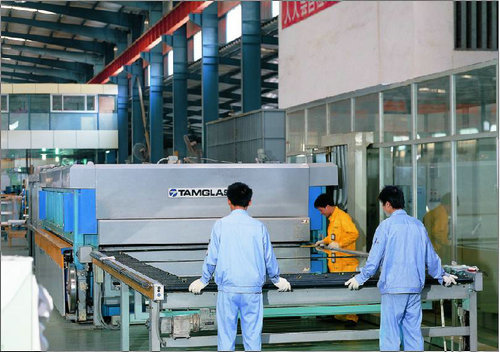
We have introduced in the newest and most advanced ProE type Radiation/Convection toughening furnace made by the famous Tamglas company,to ensure the toughened glass products during the heating process to hold flatness of the surface and consequently to obtain its better optical quality。

Semi-Toughened Glass, also known as Heat Strengthened Glass,its manufacturing process is similar to the Toughened Glass made by quickly cooling the annealed float glass when it is heated near to its softening point. During the cooling procedure, both the pressure of the cooling air and cooling speed are lower and slower than the Toughened Glass, therefore the temperature difference between its interlayer and the surface will be relatively narrower, causing the density difference between them smaller,hence the tensile stress formed inside the glass plate also will be smaller.

Properties

Toughened glass is physically and thermally stronger than regular glass. The greater contraction of the inner layer during manufacturing induces compressive stresses in the surface of the glass balanced by tensile stresses in the body of the glass. For glass to be considered toughened, this compressive stress on the surface of the glass should be a minimum of 69 megapascals (10,000 psi). For it to be considered safety glass, the surface compressive stress should exceed 100 megapascals (15,000 psi). The greater the surface stress, the smaller the glass particles will be when broken.

It is this compressive stress that gives the toughened glass increased strength. This is because any surface flaws tend to be pressed closed by the retained compressive forces, while the core layer remains relatively free of the defects which could cause a crack to begin.

Any cutting or grinding must be done prior to tempering. Cutting, grinding, and sharp impacts after tempering will cause the glass to fracture.

The strain pattern resulting from tempering can be observed with polarized light or by using a pair of polarizing sun glasses.

Uses

Toughened glass is used when strength, thermal resistance, and safety are important considerations.

  • 1/8″ – used in storm windows, picture frames, end tables, insulated units, etc.
  • 3/16″ – used for small table tops, insulated units, small shelves, etc.
  • 1/4″ – used in table tops (as protective covering), insulated units, single-pane windows, lightweight shelves, hand rails, framed shower doors, etc.
  • 3/8″ – used in shower doors, table tops, glass walls, glass partitions, hand rails, door lights, etc.
  • 1/2″ – used for shower doors, table tops, glass walls, glass partitions, hand rails, etc.
  • 3/4″ – used for glass doors, mall fronts, table tops, glass floors, etc.

templed

Automobiles
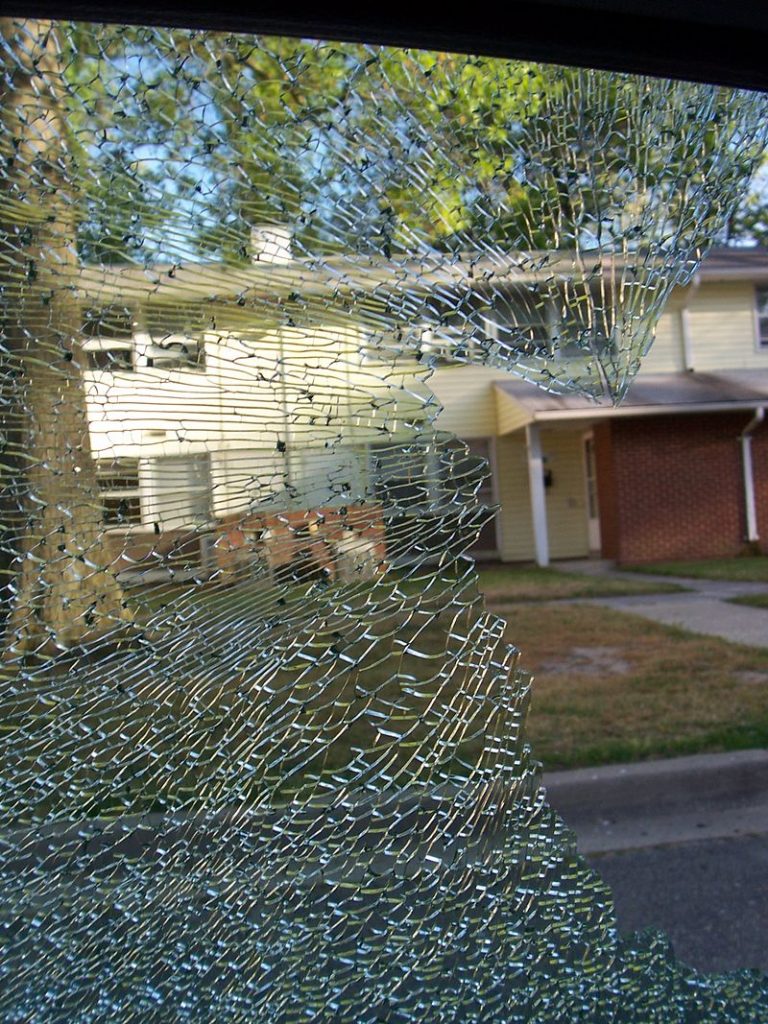
The most commonly encountered tempered glass is that used for side and rear windows in automobiles.A shattered driver’s side window reveals small fragments that still cling together.

It is used for its characteristic of shattering into small cubes rather than large shards and is sometimes referred to as safety glass in this context. (The windscreen or windshield is instead made of laminated glass, which will not shatter when broken.)

Buildings and structures
Toughened glass is also used in buildings for unframed assemblies (such as frameless glass doors), structurally loaded applications, and any other application that would become dangerous in the event of human impact. Tempered and heat strengthened glass can be three to seven times stronger than annealed glass.
[1] Building codes in the United States require tempered or laminated glass in several situations including some skylights,
[2] near doorways and stairways, large windows, windows which extend close to floor level, sliding doors, elevators, fire department access panels, and near swimming pools.

Food service
“Rim-tempered” indicates that a limited area, such as the rim of the glass or plate, is tempered and is popular in food service. However, there are also specialist manufacturers that offer a fully tempered/toughened drinkware solution that can bring increased benefits in the form of strength and thermal shock resistance. In some countries these products are specified in venues that require increased performance levels or have a requirement for a safer glass due to intense usage.

Tempered glass has also seen increased usage in bars and pubs, particularly in the United Kingdom and Australia, to prevent broken glass being used as a weapon.

Cooking and baking
Some forms of tempered glass are used for cooking and baking. Manufacturers and brands include Glasslock, Pyrex, Corelle, and Arc International.

Mobile Devices
Most touchscreen mobile devices use some form of toughened glass (such as Corning’s Gorilla Glass[3][better source needed]), as do some aftermarket screen protectors for these devices.

Disadvantages

Toughened glass must be cut to size or pressed to shape before toughening, and cannot be re-worked once toughened. Polishing the edges or drilling holes in the glass is carried out before the toughening process starts. Because of the balanced stresses in the glass, damage to any portion will eventually result in the glass shattering into thumbnail-sized pieces. The glass is most susceptible to breakage due to damage to the edge of the glass, where the tensile stress is the greatest, but shattering can also occur in the event of a hard impact in the middle of the glass pane or if the impact is concentrated (for example, striking the glass with a hardened point).

Using toughened glass can pose a security risk in some situations because of the tendency of the glass to shatter completely upon hard impact rather than leaving shards in the window frame.

The surface of tempered glass does exhibit surface waves caused by contact with flattening rollers, if it has been formed using this process. This waviness is a significant problem in manufacturing of thin film solar cells.The float glass process can be used to provide low-distortion sheets with very flat and parallel surfaces.

lamitations holes

cut outs

]]>