Insulating glass units are designed to keep buildings warmer in the winter and cooler in the summer. A standard IGU consists of two lites of glass with four surfaces.For greater levels of insulation, three lites of glass can be used.
The performance of an IGU can be further enhanced by adding low-e coatings and filling the space between the lites with a noble gas such as argon or krypton. These gases are denser than air and reduce the amount of heat transfer through the IGU.
When 90 percent argon gas-fill is used in a low-e IGU instead of air, the window’s insulating value can be improved by up to 16 percent. Krypton can improve the insulating value in a low-e IGU by up to 27 percent.
However, even with that performance differential, gas-filled IGUs are more practical for residential windows than for large commercial buildings. Unlike homes, large commercial buildings can save the most energy by preventing solar heat radiation from even entering the building because by doing so it helps contain air conditioning costs. It’s for this reason that commercial glass design focuses more on reducing the Solar Heat Gain Coefficient than on increasing insulating properties.
Another reason gases aren’t typically recommended for commercial applications is the risk for gas leakage. The partial pressure differentials between the air outside and the gas inside cause both argon and krypton to naturally escape an IGU. Even when an IGU is perfectly constructed, the gas will escape at a rate of about one percent per year, and that rate is much faster when the IGU is poorly made.
As the gas leaks out, the IGU loses insulating performance, and, since air doesn’t backfill into the IGU, the two lites of glass begin to collapse into the center of the unit, which can cause the glass to look distorted or even break. This can be a major problem on a commercial building especially if it has an all-glass curtain wall construction.
In addition, while argon gas is relatively cheap, it can result in a slower cycle time in fabrication, which also adds to increased costs. And, while Krypton performs much better than argon, it can be very expensive—up to 1,000 times more than Argon. Krypton also has the same added fabrication time and costs that you find with Argon. Furthermore, there’s no easy way to measure the gas fill after installation to know if it’s even in the IGU and at the correct fill percent.
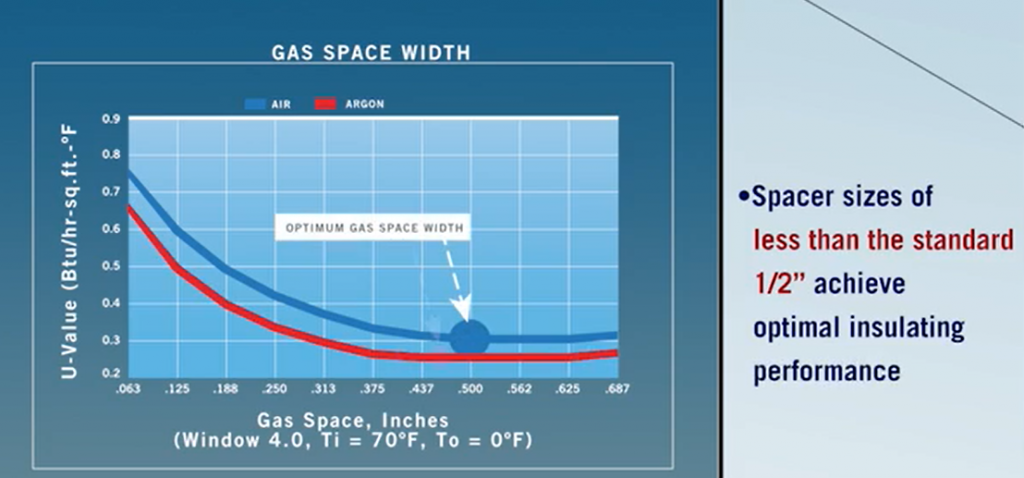
Finally, both argon and krypton achieve optimal insulating performance in spacer sizes less than the standard 1/2 inch, making it impractical to specify commercial IGUs in these thicknesses.
Today’s reflective glasses have evolved and now feature varying levels of reflectivity that create a wide range of aesthetics. The mirror box effect is definitely a thing of the past! Below are some key benefits to designing buildings with reflective glass:
 Color: Tinted, reflective architectural glasses offer better harmonization with spandrels, metal panels, extrusions and other building materials. This color enriched glass transmits generous levels of visible light and offers color neutrality, which also enhances the tint of the glass substrate underneath the reflective coating. Today, reflective glasses can also include low-e coatings.
- Visibility: Reflective glass also has a special metallic coating that makes it possible to see out, while preventing people from seeing in, in order to preserve privacy during the day. In addition, reflective glass makes it possible to hide computer wires, vents, fans, HVAC components and other building mechanicals.
- Glare Control: Reflective glass also impacts visible light transmittance (VLT). Reflective glass allows just the right amount of natural light into a building, while at the same time reduces glare and the need for window blinds and other interior shading devices. In addition, reflective solar control glass reflects a portion of incoming solar radiation, which limits heat penetration into the building and can potentially lower HVAC usage.
- Exterior Appearance: Reflective glass provides a bold, crisp exterior appearance, along with a dynamic building surface that changes to reflect the color of the sky, the passing of clouds and the different times of day.
Improvements in manufacturing, and enhanced energy efficiency from high performance, low emissivity coatings and spectrally selective tinted glass have made specifying large glass units easier and easier. However, while it’s gotten easier, there are several factors that need to be considered in order to ensure a successful project when specifying large insulating glass units.

- Wind Load: Heat treating helps with wind load, but it doesn’t help with the center of glass deflection. Deflection occurs when the glass physically bows into or out of the building because of positive and negative wind loads. Excessive deflection may cause discomfort and/or concern the occupants of the building, and could potentially result in loss of edge support of the IG.
- Thermal Stress: A thermal stress break is a possibility with glass and that’s especially true with large panels. A thermal stress break occurs when the center of the glass becomes hotter than the edge of the glass that expands – and the resulting stress then exceeds the strength of the edge. Because of the long perimeter of the edge, large IGUs have an even greater risk for thermal stress breaks. The most likely time of day for a thermal break to occur is at sunrise. This is because during the night, the glass panel becomes cool, then when the sun comes up and hits the glass, the glass warms up quickly, which puts stress on the cooler edges. To ensure a large glass unit will perform under the anticipated thermal loads,.
- Heat Treating: With units of this size, chances are that the glass will need heat treating. However, while heat treating makes glass more resistant to wind loads and thermal stress, it also increases the chance of distortion.
- Fabrication: Large glass units can be tough to handle during fabrication. Large pieces of glass are simply more difficult to manage through the fabrication process than smaller ones. In addition, larger glass units tend to have more issues with spacers and seal ruptures, distortion and damage within the sealed air cavity.
Weight: Large glass units are HEAVY– and that weight increases the chance of damage during fabrication, handling and glazing. One way to help prevent damage includes making sure that both the glazing contractor and the glass fabricator have the proper capabilities, equipment (such as lift assist equipment/cranes/etc.), and experience in handling large IG’s.
Field Issues: Large glass can be extremely unwieldy, and that means the people working with it have to be extra careful to prevent it from breaking or damaging the edges and from being exposed to temperature extremes, which can also cause breakage. It’s essential that the glazing contractor working on the project put safety first, including having enough people, the right equipment on hand to prevent injuries, and experience in working with large IGs.
Glazing: Large glass units require a glazing system that is specifically designed for these types of units because the system needs to be able to support the heavy weight of the glass. This is also where cost and budget come into play. Different glazings have different costs – you have to weigh the cost of a particular glazing versus the benefit it provides.
]]>While nickel sulfide breaks are extremely rare, it’s still very helpful to understand how spontaneous breakage due to nickel sulfide can sometimes occur.
When glass goes through the tempering process, it becomes four to five times stronger than standard annealed glass, making it great from a safety perspective. However, nickel sulfide stones that can form during the production of float glass due to nickel contamination, can end up in the center tension zone of tempered glass. When that piece of tempered glass is later exposed to varying temperatures in its final installed position, this tiny stone – which can measure from 0.003 to 0.015 of an inch in diameter – may grow in size, and cause the glass to shatter for no apparent reason.
Again, while a nickel sulfide stone is one potential reason for spontaneous glass breakage, there is almost always a more common explanation, such as glass edge or surface damage from handling and glazing, building or framing system movement, or poor engineering.
There are several facts to keep in mind about nickel sulfide and its role in glass breakage:
- Spontaneous breakage caused by nickel-sulfide stones occurs only in tempered glass, not in annealed or heat-strengthened glass. For this reason, kingglass recommends heat-strengthened glass whenever heat-treated glass is needed, except where building codes require a safety glazing.
- There is no known technology that completely eliminates the possible formation of nickel sulfide stones in float glass. And because nickel sulfide stones are so small, there is no practical way to inspect their presence in float glass.
- ASTM guidelines permit blemishes, including nickel sulfide stones, of between 0.020 and 0.100 of an inch depending on glass size and quality level…much larger than the typical nickel sulfide stone size.
- Most North American glass makers have controls that greatly reduce the likelihood of nickel sulfide formation. At kingglass, we don’t use nickel in any of our primary batch formulations and our glass plants use magnetic seperators. In addition, nickle bearing metals are banned from all of our operations.
- Heat-soaking after fabrication may destroy some flawed glass panels, but the procedure does not guarantee 100 percent elimination of nickel sulfide inclusions. In addition, the heat-soaking procedure can increase costs, cycle times and scrap rates.